
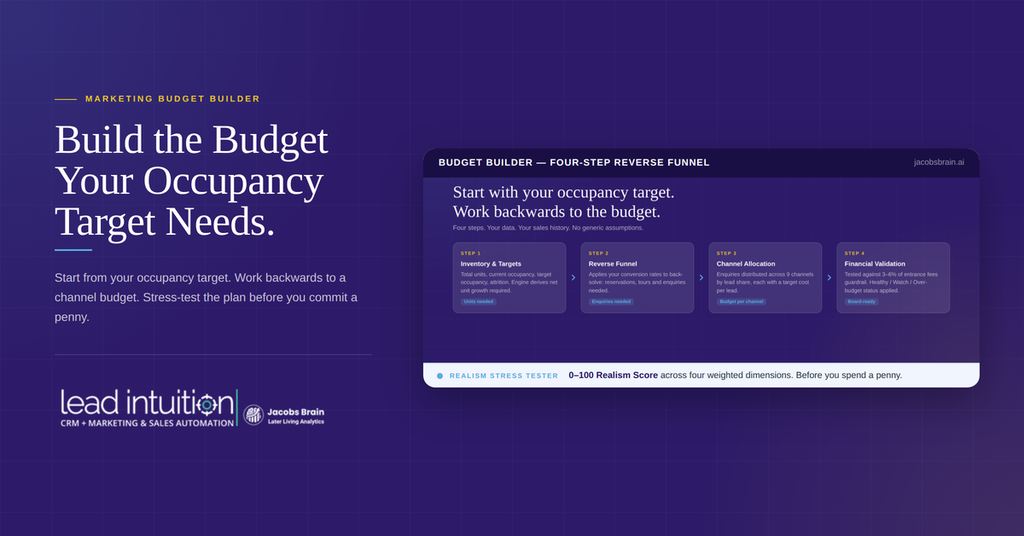
How Jacobs Brain’s Later Living Marketing Budget Builder and Stress Tester gives UK Later Living operators a plan their board can defend and reality can deliver
Budget season puts a familiar pressure on Later Living marketing teams. The brief arrives from the board: an occupancy target, a revenue expectation, a timeline. The team retreats to its spreadsheets to work out what it will cost to get there. A percentage is added to last year’s spend. A few channel allocations are adjusted. The resulting number goes to the board, who challenge it. Then a revised version is agreed in a different room from the one where the occupancy target was set. The two are rarely reconciled until the year is already lost.
The consequences are well understood. Targets that were never mathematically deliverable from the enquiry volume the plan funds. Marketing spend defended on gut feel rather than cost per unit sale. Plans that treat Q4 enquiries as if they will complete inside the plan year, ignoring the length of the Later Living decision cycle entirely. And no visibility of channel saturation until the money has been committed.
Jacobs Brain’s Later Living Marketing Budget Builder replaces all of this. Not just with a better planning tool, but with something more fundamental. A platform that has already been collecting, analysing and benchmarking the data the budget needs before you open the planning screen.
Why most Later Living budgets fail before the year starts
The budget and the occupancy target are built separately, reconciled late, and tested against reality not at all. Most spreadsheet-built plans share three weaknesses. First, they rely on assumptions rather than evidence. What the team thinks channels cost, what conversion rates they hope to see, how long they expect the sales cycle to run. Second, they ignore the Later Living decision cycle entirely, counting Q4 enquiries as in-year completions when the lead times make that all but impossible. Third, they have no mechanism for stress-testing the result before the board sees it or the spend is committed.
The consequence is familiar. A plan that looks reasonable in October, shows signs of strain in March, and is quietly acknowledged as lost by September.
The data behind the plan
A marketing budget is only as good as the assumptions it rests on. What did each channel actually cost per enquiry last year? What was the real conversion rate from enquiry to tour, and from tour to reservation? How long does it take from first contact to completed sale in your community? What percentage of reservations are cancelled before completion?
These are not planning assumptions. They are performance facts. And they are already inside the Jacobs Brain platform, generated continuously by its six intelligence modules.
What Jacobs Brain already knows about your community
Marketing ROI Visibility tracks cost-per-enquiry and channel quality across nine standard channels, benchmarked against UK Later Living sector averages. It tells you not just what each channel costs but whether the enquiries it produces are any good.
Conversion Funnel Intelligence: maps every stage of the sales journey from enquiry through visit, reservation and completion. Automated bottleneck detection identifies where prospects drop off. Quality scoring at every stage means you know not just how many leads you have but how good they are. The conversion rates this module has measured from your community and your actual pipeline are the same rates the Budget Builder uses to back-solve the funnel.
The Sales Velocity Index: consolidates pipeline volume, conversion rate, deal quality and cycle time into a single 0-100 composite score. The cycle time component, meaning how long it actually takes from enquiry to completion in your community, feeds directly into the Budget Realism Stress Tester’s time-lag dimension.
AI-Powered Diagnostics: run across all of this data and surface specific, actionable recommendations. The platform scores your performance against sector benchmarks and tells you where to act. Those diagnostics inform the Stress Tester’s findings.
Site and Context Analysis: goes beyond internal metrics. It scores your community across neighbourhood demographics, local housing market conditions, competitor proximity and local Points of Interest,. All benchmarked against UK Later Living averages. The catchment population data it generates, covering qualified over-65s at five, ten, fifteen and twenty mile radii, feeds directly into the Budget Realism Stress Tester’s market ceiling dimension.
Business Intelligence Reporting: synthesises all of this into professional, board-ready documents with AI-written, editable executive summaries. The budget and the performance report tell a connected story, because they draw from the same source.
By the time you open the Budget Builder, the platform has already done the groundwork. Your conversion rates are measured. Your channel costs are benchmarked. Your sales cycle length is known. Your catchment population is analysed. You are not filling in assumptions. You are confirming facts.
Start from the occupancy target. Work backwards.
The Jacob’s Brains Later Living Marketing Budget Builder begins from the only number the board actually cares about: target occupancy. It then works backwards to the marketing budget required to achieve it.
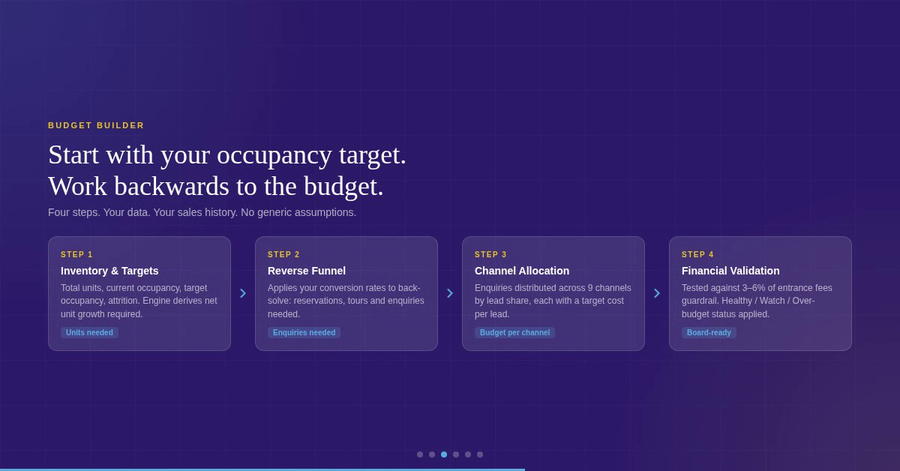
The four-step reverse funnel
The four-step flow is direct. Step one takes total units, current occupancy, target occupancy and expected annual attrition to derive the precise number of unit sales the year must deliver, including attrition, which most operator spreadsheets under-count. At this point you can optionally add any reservations in the current year, that will carry over into next year’s early completions. Step two applies your community’s conversion rates, drawn from Conversion Funnel Intelligence, to back-solve the pipeline: how many reservations, tours and enquiries are required. Step three distributes those enquiries across the nine channels at your historically observed lead shares and target costs per lead, informed by what Marketing ROI Visibility has already measured. Step four validates the whole plan against revenue: marketing spend as a percentage of entrance fees, cost per unit sale, and a healthy or watch or over-budget status against the 3-6% of entrance fees industry guardrail.
The result is a budget in which every pound is traceable to a unit sale. Marketing spend stops being a cost line to be cut. It becomes an occupancy investment with a stated return, one that your board can interrogate because the assumptions behind it are your own data, not a generic template.
Planning across the year
Monthly seasonality pacing spreads the plan across twelve editable periods, turning an annual number into an operational plan your team can manage and track against actuals every month. Multiple named scenarios can be saved and presented to the board in a single comparison table, covering conservative, base and stretch cases side by side.
For newer communities not yet ready to build a full budget, Quick Targets provides a lighter entry point. A handful of headline numbers expand into a complete, valid plan within minutes of onboarding. Just by using transparent benchmark defaults wherever community history is not yet available.
Does the plan survive contact with reality?
A plan that adds up arithmetically may still be undeliverable. That is the problem the Budget Realism Stress Tester addresses. Once a scenario has been built, the Stress Tester interrogates it across four weighted dimensions and returns a 0-100 Realism Score: Achievable (80-100), Moderate Risk (50-79) or High Risk (0-49).
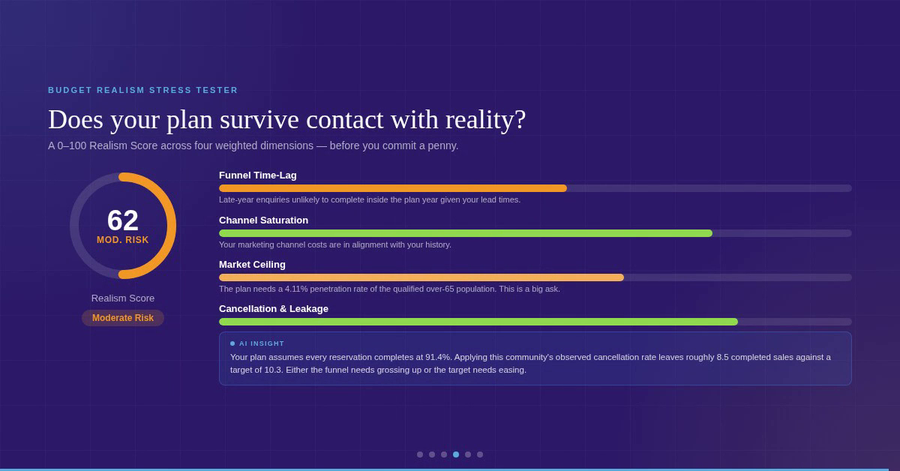
The four stress-test dimensions
Funnel time-lag: tests whether your plan can physically deliver inside the plan year. It uses your community’s own lead times from enquiry to reservation and reservation to completion, the same cycle time data already captured by the Sales Velocity Index.
Channel saturation: tests whether each channel is being asked to deliver beyond its historical capacity and at a cost per lead the market has supported, drawing on what Marketing ROI Visibility has measured.
Market ceiling: tests your required enquiries and move-ins against the qualified over-65 catchment population in your area, using the demographic data already generated by Site and Context Analysis.
Cancellation and leakage: re-runs your scenario with your actual cancellation rate applied, exposing the shortfall in completed sales.
Each dimension produces a specific AI Insight where the plan is under stress. The platform does not just flag a problem. It quantifies it and explains what it means for your targets.
If the plan scores Achievable, you go to the board with confidence. If it scores Moderate Risk or High Risk, you know exactly which dimension is the problem and why. And there is still time to adjust the plan rather than explain why the year was missed.
A budget built on everything the platform knows
This is what separates Jacobs Brain’s Budget Builder from any spreadsheet or standalone planning tool. The data it uses is not entered at budget time and forgotten. It is continuously updated throughout the year by the platform’s intelligence modules: your real channel costs, your real conversion rates, your real sales cycle, your real cancellation history. Every month of Plan vs Actual reporting through the year refines those inputs further, so the following year’s budget is built on an even more accurate foundation.
The budget is not separate from the platform. It is the platform’s data, expressed as a forward plan.
Available through Lead Intuition in the UK and Ireland
Jacobs Brain is available to Later Living operators in the UK and Ireland exclusively through Lead Intuition, the platform’s authorised reseller. Lead Intuition handles demonstrations, implementation, training and ongoing technical support, with a UK-based team available during business hours by phone, live chat and email.
Visit jacobsbrain.ai to learn more, or contact Lead Intuition to arrange a demonstration with a UK Later Living specialist.
T. 01603 552696 · hello@leadintuition.co.uk