
A thought leadership piece from Lead Intuition
Generic CRMs track transactions. A Later Living CRM helps operators understand people, families and decisions that unfold over months or even years.
Ask any sales director in our sector how long a typical move takes. The answer rarely fits a standard property cycle. A prospect might enquire, attend an open day, then go quiet for a year. When they return, they expect you to remember them.
Most generic CRMs struggle with this. Platforms such as Salesforce and HubSpot are powerful tools. Yet their makers built them for linear pipelines and fast transactional sales. Later Living works differently, and operators feel that friction every day.
A life decision, not a property transaction
A move into a retirement community often follows a significant life event. It may come after a bereavement, a health scare or a fall. It may mean leaving a much-loved family home after decades. Prospects weigh up independence, security, finances and identity all at once.
That emotional weight stretches the buying cycle. It also changes what good follow-up looks like. A generic CRM counts days in stage and nudges teams to close. A Later Living team needs to know where someone stands emotionally, not just commercially. Push too hard, too early, and you can lose a prospect for good.
A purpose-built Later Living CRM supports patient, well-timed engagement. It keeps a complete history across long gaps in contact. Engagement-based lead scoring flags the moment a quiet prospect starts revisiting your website. Your team can then reach out at the right time, with the right message.
Adult children and influencers shape the decision
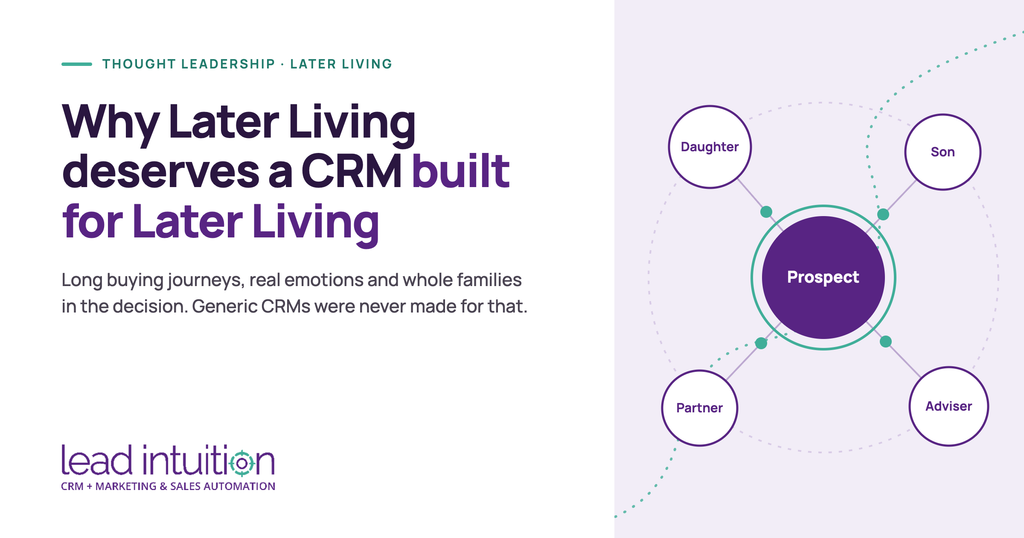
Adult children often shape the outcome. So do partners, siblings, friends, solicitors and financial advisers. A daughter may research care options late at night. A son may hold lasting power of attorney. Each of these people forms a view of your community.
Generic CRMs usually treat them as separate contacts, or ignore them altogether. Insight then scatters across inboxes, spreadsheets and individual memories. When a sales consultant leaves, that knowledge leaves with them.
Operators need every influencer linked to the prospect’s record. They need to see who opened which email and who viewed which page. If a son has looked at your care pages three times this week, your team should know. One shared view lets you tailor each conversation to whoever matters most at that moment.
What else a Later Living CRM must handle
Beyond the long cycle and the family dynamic, several other needs separate Later Living from mainstream sales.
- Mixed tenure and care. Many operators offer sales, rental and care, sometimes on one site. Your CRM should understand unit inventory, waitlists and bed occupancy alongside the pipeline.
- Life after reservation. A reservation is not the finish line. Buyers often need to sell a home, manage a chain and pass AML checks before exchange. Tracking that progression protects revenue and reduces fall-throughs.
- Tours and events. Open days, lunches and show apartment visits drive conversion. Your CRM should record each outcome against the right prospect.
- Sector reporting. Boards and investors want occupancy, sales velocity and forecasts, not generic deal metrics.
- UK GDPR by design. Prospect records hold personal details about older people and their families. Operators need a platform built for UK GDPR from the ground up, not adapted to it later.
You can bend a generic CRM to fit some or most of this, but it costs development time and budget. It often relies on consultants, add-ons and workarounds that few staff fully understand.
The next generation of Later Living CRM
LivingMetrics™ from Lead Intuition is a person-centric CRM built for UK Later Living. It follows each prospect from their first website visit through to exchange. It links family members and influencers to every record, so your team sees everyone’s engagement in one place. It works across sales, rental and care settings, from independent living and assisted living to care homes and memory care. Its AI runs on a sector-specific language model and summarises journeys and calls, while your team stays in control. Operators also get unlimited users and a single login across every community. It also integrates seamlessly with ActiveDEMAND, Microsoft 365, Jacobs Brain, Slack and your other business tools.
Later Living is a people business. Your CRM should be one too.
If you are reviewing how your CRM supports your sales and marketing teams, we would welcome a conversation. Call Lead Intuition on 01603 552696, or visit leadintuition.co.uk/livingmetrics-crm to start the discussion.