
In digital marketing, we are often drowning in data but starving for insights. We spend thousands, sometimes millions, on multi-channel campaigns. Yet when it comes time to answer the simplest question (“Which specific touchpoint actually closed this deal?”), the dashboard often returns a shrug. The culprit isn’t usually the software, the platform or the strategy. It’s a lack of structural consistency. Specifically, it is the absence of standardised rules in our UTM Source/Medium pairs for how we tag our traffic through our systems and how we name our successes.
When agencies and internal teams use arbitrary UTMs and naming conventions, they aren’t just being “messy”, they are sabotaging the company’s ability to calculate ROI. To find the “real truth” of digital attribution, stop treating data standards as an afterthought and start treating them as a core financial protocol.
The Chaos of Arbitrary Data
In a scenario where your sales team is looking at high-value Leads in the CRM. Under the “Source” field, one lead says FB, another says Facebook.com, a third says Paid_Social, and a fourth simply says Social.
To a human, these may well all mean the same thing. To a database, these are four entirely different entities. When your data is fragmented by inconsistent tagging, your reporting becomes a manual chore. Analysts have to spend time “cleaning” data, standardising names and merging rows, just to get a baseline view of performance. By the time the report is ready, the data has cooled off, and the opportunity to optimise has passed.
Establishing the “Real Truth” UTM Taxonomy
To fix the confusion, we must move away from individual Source/Medium preference and toward a Standardised Taxonomy. This means defining exactly which “Source” is allowed to be paired with which “Medium.”
The Source/Medium Pairing Matrix
The following table represents the “Real Truth” model. It ensures that every stakeholder, whether an internal hire, system admin or an external agency, is speaking the same language.
| Channel Category | utm_source (The Origin) | utm_medium (The How) | The Logic |
| Search Engine Marketing | google or bing | cpc | Distinguishes paid clicks from organic search |
| Paid Social Media | linkedin or facebook | paid-social | Separates paid ads from organic posts |
| Organic Social Media | linkedin or twitter | social | identifies traffic from unpaid brand updates |
| Email Marketing | newsletter or nurture | Tracks the intent on the message | |
| Referral | partner-site-dot-com | referral | For 3rd party traffic and co-marketing |
| Influencer & Affiliate | influencer-paul-smith | social | Track and measure each influencers traffic |
Defining the Result: Speaking One Language
Standardising the input (UTMs) is half the battle. We must also standardise the output. A point of friction between Marketing, Sales, and Data teams is a gap in what we call a “result.”
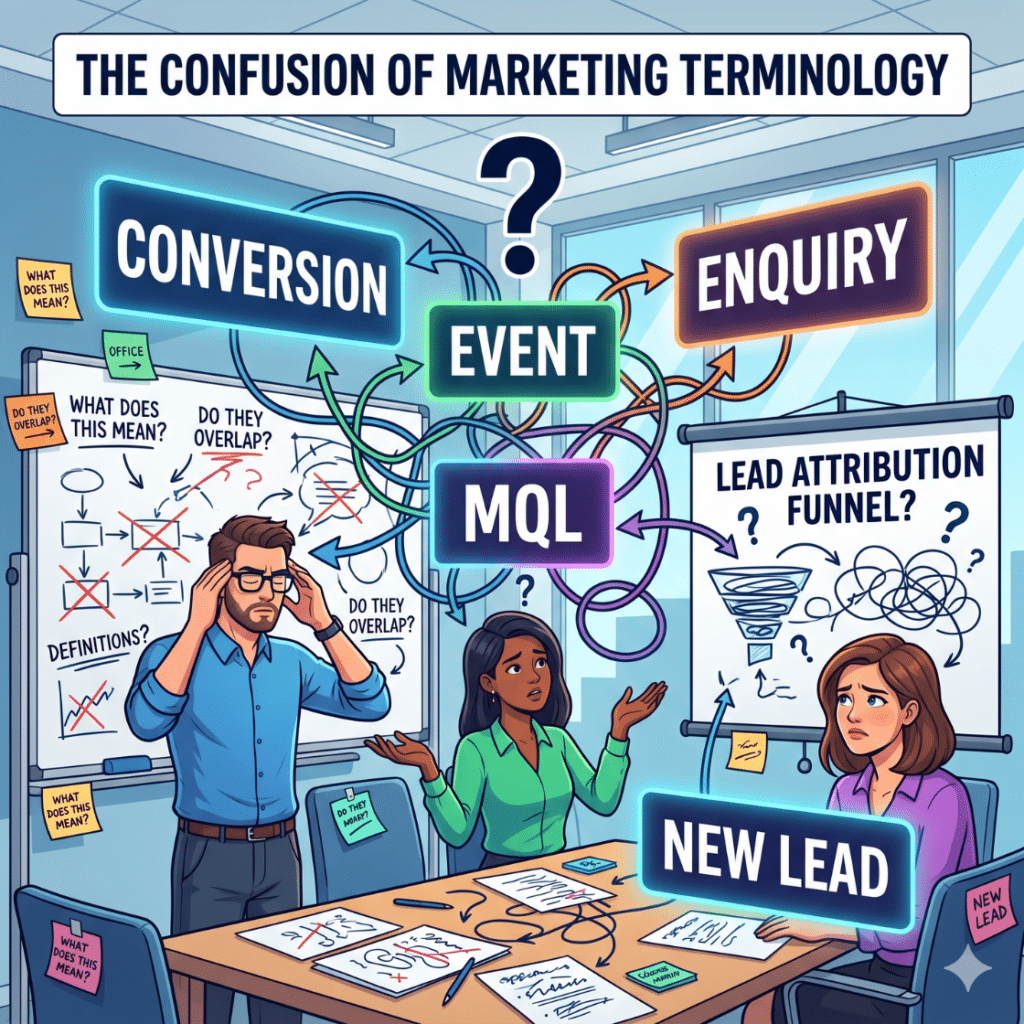
Marketing exists to generate leads, but “Lead” has become a shapeshifting term.
Depending on who you ask and which platform you look at, a single person filling out a form might be labeled differently:
GA4 calls it a “Conversion” or a “Key Event.”
The Agency calls it an “Enquiry.”
The MAP (Marketing Automation Platform) calls it an “MQL” (Marketing Qualified Lead).
The CRM simply calls it a “New Lead.”
When these terms are used interchangeably without a shared dictionary, the “Real Truth” disappears. If an agency report claims 100 “Conversions” but the CRM only shows 40 “New Leads,” the business loses trust in the data.
The Unified Lexicon
To achieve true performance reporting, we must align these definitions across all platforms:
- The Event (GA4): The technical action (a button click, a tracked phone call or form submission).
- The Enquiry (Agency/Front-end): The raw notification that someone wants to talk.
- The Lead (CRM/MAP): The unique individual record created in our database.
By ensuring our Agency Reports, GA4 properties, and CRM dashboards all use the same terminology for the same lifecycle stage, we eliminate the “data lag” that occurs when teams try to reconcile different numbers.
The Four Pillars of UTM Source/Medium Data Integrity
To maintain this system, every link generated and every report filed must follow four non-negotiable rules:
1. Always Lowercase
This is the most common point of failure. Email, EMAIL, and email are three different things (tags) to a database. By mandating lowercase across the board, you eliminate 90% of data fragmentation overnight.
2. No Spaces, Ever
Spaces in a URL are unstable. They often convert to %20, which makes your CRM data look cluttered and breaks simple filters. Use dashes (-) to separate words. For example: summer-campaign, not summer campaign.
3. Source is the “Who,” Medium is the “How”
The Source is the platform (where the user was), and the Medium is the vehicle (how they got to you). You wouldn’t put “Airplane” as your destination and “London” as your mode of transport; don’t do it with your data.
4. Zero Tolerance for “Creative” Tagging
Agencies often want to use their own proprietary naming and UTM Source/Medium conventions as they have a system. While well-intentioned, this creates “data silos”. This requires every partner to map their internal nomenclature to the agencies Standardised Taxonomy (In Marketing Automation, CRM & Analysis and BI systems. If it isn’t in your approved UTM list, it doesn’t go live.
5. Document your Naming Conventions
Something as simple as a shared Google Sheet works, or produce a SOP (Standard Operating Procedure). Get together with all stake holders across the process and agree & document the basics.
The Long-Term ROI of Order
When you enforce consistency in both UTMs and terminology, the benefits compound over time.
- Executive Visibility: Leadership can finally see a “Revenue by Channel” report that is accurate and real-time.
- Accountability: You can compare the performance of different agencies or even tools like chat systems side-by-side because they are using the same metrics and naming conventions.
- Sales Context: When a Sales rep calls a lead, they see exactly what the user clicked on. If the underlying metadata is clean, the conversation is relevant.
Clean, consistent UTM parameters are one of the simplest tools in the digital toolbox. By spending a little time agreeing and implementing these conventions the payback is very quick. Standardising our UTM source/medium pairings and our conversion definitions, we move from a culture of “we think this works” to a culture of “we know this works.” Consistency is the only way to ensure that every marketing £ / $ spent is accounted for.